Showing posts with label beginner's guitar. Show all posts

Friday, May 31, 2013

How to Read Guitar Tabs


Hello again! Still busy memorizing Jesu. I'm slightly addicted. By day three I expected to go stark mad over the repetitions. I didn't expect that the more I played this one, the more I'd learn to love it. Now here I am, head over heels - or rather, finger-tied. At some point a day ago, I had to quit because of a lingering pain above the wrist. I think it was because of the pressure I placed on the pinky whenever I played Romance/Jeux.


Today the pain is slight, but it's still there. Rest rest, but I can't because Jesu sound just so right :)

***end of introduction

SO! This post is about how to read guitar tabs. This comes as a reply to a friend who mentioned that tabs looked complicated. In all fairness, I felt the same way. I still remember how I read a barre chord erroneously, thinking it was impossible to press all 6 strings at once. I thought the barre itself went something like, choose one of the 6 strings. But no! All strings in a barre must be pressed... the biggest shock of my life! I almost wanted to stop playing then. I actually hate barring because it's painful and tiresome to play. Nakakangawit. But it can't be helped. Two of the major chords are played with a barre (F and B). Power chords are in barre (except if the shortcuts are used).

Before starting with chords, here are a few guidelines.

Names of the strings. Yes, they have names. The thickest, the one closest to the player's face when the guitar is at playing position, is called the 6th string. The thinnest is the 1st string. So from the player's point of view, from thickest to thinnest, the string names are: 6th, 5th, 4th, 3rd, 2nd and 1st. Not bad, huh?

Guitar Standard Tuning. The standard notes of each string follows thus:  E-A-D-G-B-e. In the absence of an electronic tuner, guitarists can tune the strings by ear (or oido, a music savant who can identify tones by ear), using this nifty site.
taken from http://www.start-playing-guitar.com/

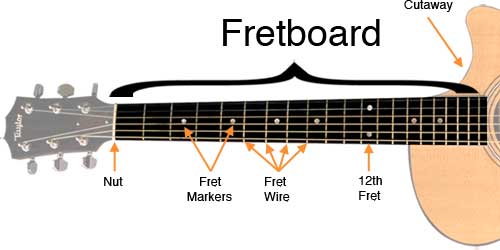
Fret. The parallel lines on the fingerboard that are perpendicular to the strings. When a number precedes the word "fret," this means a particular spot between frets. Markers on the fingerboard help guitarists pick out higher frets with a glance. These are placed in the 3rd, 5th, 7th, 9th and 12th frets.

Left hand finger names. Yes, they have names too! Unfortunately! They are also designated by numbers! They are 1: pointer, 2: middle, 3: ring and 4: pinky.

Open strings. Strings that are played without pressing on the strings. Denoted by the symbol 0 (zero).

Palm mute. Strings that are played muted or not played at all. Denoted by the symbol X.

Reading Guitar Tabs

Let's take the major chord C. This is how it looks like in real life:

Front view. Taken from http://www.guitar-beginner.com/

Guitarist's point of view. Taken from http://www.1stpersonguitar.com
Notice where the fingers go. There are three things to take note: the string pressed, the fret where the string is pressed, and the finger that does the pressing. For C chord, the strings are 5th, 4th and 2nd. The frets are 3, 2 and 1 respective of the strings. The fingers used are 3, 2 and 1 respective of the strings.

Chords are notated in different ways. We'll examine three of the most common types for this exercise.

One of these is the horizontal notation*, like so:

taken from http://www.pengustudios.com
This is the easiest to read. This follows the guitarist's point of view, the bottom horizontal line designated by uppercase E being the 6th string and the top horizontal line designated by lowercase e being the 1st string -- remember standard tuning? The leftmost line is the nut (the thickest fret, the leftmost in the fingerboard) and the succeeding vertical lines are the frets. The black spots indicate the points that are to be pressed, and the numbers on the mare the fingers to be used. X means that the 6th string should not be played.

The next notation is vertical*, like so:

taken from http://www.cyberfret.com
This one's pretty similar to the previous, except it doesn't follow the guitarist's point of view and the grid lines have been reversed (horizontal lines = frets, vertical lines = strings). Instead of the finger numbers placed inside the black spots, they're placed along the vertical lines. 0 means that these strings are played without pressing the strings, as indicated by the absence of black marks on the respective lines.

Horizontal and vertical notations are used in chord books and playing guides. The following two are called the linear notation*, the root of all complications. These two are favorites among Ultimate-Guitar users, so there's no escaping learning them.

The first one looks like a phone number to some lonely telephone booth. The other looks like a code for some confidential military report. Granted, they don't give as much information as the first two notations, but they're faster to read once the guitarist has mastered the basics.


This notation looks a lot like the vertical notation, doesn't it? Actually, the numbers designate which frets to press, not which fingers to press with. The numbers are also arranged from 6th to 1st string, so that we have 6th string = X, 5th string = 3, 4th string = 2, and so on. For F, the notation would be: 133211, reading 6th = 1st fret, 5th = 3rd fret, 4th = 3rd fret, and so on. Which fingers to press with? That's up to you! Finger names are not indicated, which makes this notation a kind of a level above the first two notations.


This following is causing hyperventilation among newbie users of Ultimate-Guitar, but this is actually highly entertaining to read. This reads like the horizontal notation, except that the numbers designate the frets that must be pressed. Numbers that appear in a single column should be played together. In the notation above, 3 and 0, 2 and 1, and 3 and 3 must be played together, like so:

This notation is played from left to right. The notation above is played so:

3&0 (at the same time) - 0 - 2 - 0 - 2&1 - 0 - 2 - 0 - 3&3. This is Fernando Sor's Study in C (35, 13). This particular part is from 0:06-0:08 of this video. Like the other notations in this post, it's also based on the chord C - see how it uses almost the same fingering as the others, except the notation is fingerstyle.

Questions?

* The terms used here are mine, for ease of narration :)
* Horizontal and vertical notations, referring to the fingerboard position respective to the ground.

Tuesday, May 28, 2013

On Learning a New Piece

I've finished Jeux Interdits (which, btw, I learned was also called Spanish Romance or Romance) a few days ago. The piece needs more polishing, especially part two. Also, not enuf feels yet. But I lala-love the song :)

My next piece is ... Jesu, Joy of Man's Desiring. At last, at last! I'm using a cheat sheet though. I really shouldn't because I haven't been practicing reading notes. Part of the consequence is I've forgotten to play Adelita, and I haven't reviewed it yet. If it weren't for muscle memory, I swear I wouldn't budge one finger to review Carulli's Andantino in G and Waltz in Em again, which are the first classical pieces I ever learned to play.

Right now I'm still at the fourth bar of Jesu, and now that I've picked up a new piece after a few months of sabbatical I thought I should write something about how I learn a new piece.

I can't really say that there's a step by step process because at some point my fingers and memory fail me and I have to start over. But here's my best explanation:

1. Get sheet. If I can't find a downloadable copy of the piece I search for tabs in Ultimate Guitar. But I usually go straight to UG if I'm too lazy to read sheet music (which is most of the time). There are a few advantages when using sheet music though. Some sheets notate left hand fingering. I also find that when I read tabs I get impatient because the songs seem very long. Since sheet music notates those parts that are just repeated, they read pretty concise.

2. Read sheet. Now, I'm not a savant who can see notes and then automatically translate them to tones in my head. This is for me to get a general idea of the fingering or how many frets I have to traverse. I check if the distance between notes is sane and within the reach of my puny fingers. If I find it too difficult for my level, I put it aside and set my sights on other pieces.

3. YouTube. My best friend. I search for other guitarists and take note of their playing speed and how they phrase the song. A note about YT: It was by searching various interpretations that I realized guitarists have the liberty of changing the lengths of a few notes, creating their own... cadence of sorts. Some formalists may frown at how liberal an interpretation may be. But hey, who's playing?

4. Play sheet. This is the hard part. This is the true test of my patience, tolerance and interest in a particular piece. I usually go bar by bar, repeating more than once after I memorize the succession of notes and their corresponding fingering. A tab is more helpful in this case, since all I have to do is to look and then I'd know where I should place my fingers. A bad practice actually, since I am not training myself to read notes and base my fingering on them.

After I memorize a group of bars, I repeat the phrase as often as I could. By "often," I mean until my brain and muscle memory fail me. When I get too distracted, I rest. I found out that resting is a very important ingredient in learning a new piece. It's just as important as the literal rest notes on the staff. I feel that when I take a break, the nerves in my fingers and brain use the opportunity to make new connections, and really stamp the movement of my fingers deep inside my head. Muscle memory.

I realized that I often play with my guts and rely on muscle memory more than brain memory. When I use my brain, I get more distracted. I dunno. Focus is a matter of how people are used to lose themselves on a task. When I play, I literally lose myself. In moments of self-consciousness, I find that my brain has shut down and the lights are off. I don't think about what I play, I don't process what I sense. I feel I am the music that just has to come out of the instrument.

Haha, andami kong nasabi. That's it for now. El Dia's getting cold.

Thursday, May 23, 2013

Left Wrist Says Ouchies Again!

I tried to play Jeux Interdits part 2, forgetting to warm up beforehand. What did I get? Minutes' worth of ouchies!

A few pointers on correct left hand position -- correct being not just a matter of following strictly formalist classical playing; rather, a matter of warning to those who do not wish any unpleasant, painful sensations while playing.

Take a close look at the thumb position. The thumb should never - evah! - cross the palm, or else pressure when pressing the fingerboard will fall on the median nerve, a primary ingredient for wrist pain. Instead, do:


... pull your thumb out and away from the palm. Playing this way will also force your fingers to lean towards the left, making bars easier for both index and middle fingers.


PS. My MS Paint skills are once again put to the test!

Monday, February 11, 2013

The Big G

The first classical guitar piece I learned was Minuet in G by Johann Sebastian Bach.

The sheet I used covered the basic melody of the piece, sans the bass notes (rhythm). I worked from the 5th fret onward. Very easy to memorize and great for practice: the notes span up to 5 frets, so the pinkie and all the left fingers are stretched. All six strings are also covered, so the PIMA right hand can be practiced.

Minuet in G is my stretching slash warm-up piece. I play it every day, every time I pick up my guitar. I like speeding it up for better flexibility and accuracy. I used to play it non-stop, and until now I haven't tired of listening to it.

I moved on to the more complicated melody + rhythm version about a month after burning the first version. I immediately fell in love with the sound of the bass notes along with the melody. This version takes up til the 9th fret, so I can practice moving through the fingerboard. The addition of the bass notes complicates the left hand positions, but they're manageable. The sheet I linked does not have a notation for 1234 and PAMI (except the 0s there), but I use all of them... figure it out :)

My crux is always on the 19th bar. My index finger tends to look sooo out of place and awkwardly apart, and the rest of my fingers (2 and 4 especially) go crazy when I press the strings. I tend to slow down at this portion. I can swing it when I position my left hand closer to the fingerboard, but that index just shoots up sometimes I couldn't control it! Oh well, time and practice.

This piece was also my (re)introduction to sheet reading. The two sheets don't have tabs, so I was really forced to read notes. Both versions are very basic though.

I eat Big G for breakfast, lunch, merienda and dinner. Lemme know how this piece figures in your repertoire. If you use other warm-up pieces, feel free to share.


Mar 11, 2013. Just uploaded this video. Sorry for the poor audio -- I didn't use a mic when I recorded. Didn't have one. Anyway, my messy fingering clearly says this rendition sucks. As usual, I had a difficult time through the crux. My left hand fingers are also still awkwardly apart. Wild vibrato action there too. Hmmm, when in doubt record your practice sessions. Any specific pointers on improvement?

Wednesday, February 6, 2013

Happy Decade!

According to my Virtual Library, I have been playing the guitar for approximately 10 years today.

10 years, my gah!

And what have I to show for it?

Shaky fingers, stringy sounds, long gaps, cringe-inducing phrasing and furrowed brows. Still.

But! I have moved on from pop songs to classical pieces. I started last year. I was amazed to find out how tremendously tenacious Grade 7 music class could be. Every Good Boy Does Fine. E-G-B-D-F corresponding to the lines on the staff. F-A-C-E to the spaces. #hashtags for sharps. A particularly snobbish "b" for the flats. Thanks, Ms. Apilado (Yes, I remember her name. As well as the length of her hair and the way she twirled the loose strands, one hand reaching way across her back while with the other conducted the class on a number of church hymns). These four basic tenets got me through reading the sheet music for Bach's Minuet in G.

And all I thought then was just to get passing marks on tests and how unfair it was that I had to sit through class while some classmates merely played the piano and sang under direct tutelage in their separate music sessions.

Oh well.

Five months after the life-changing switch to classical and I'm still playing Minuet. I've been playing this piece so much my brother can cue in the rougher parts and Mama can point out my recurring mistakes. Heck, even if I drop playing it now I think it'll stick well.

Anyway, Happy 10 Years my lovely calloused fingers! My pumped up veins and tired wrist! I'm still having trouble with bars and hammers, but my left pinkie is happily robust and growing more confident every day!